Osteoporosis After 50: Bone Density Tests, Fracture Risk and Prevention
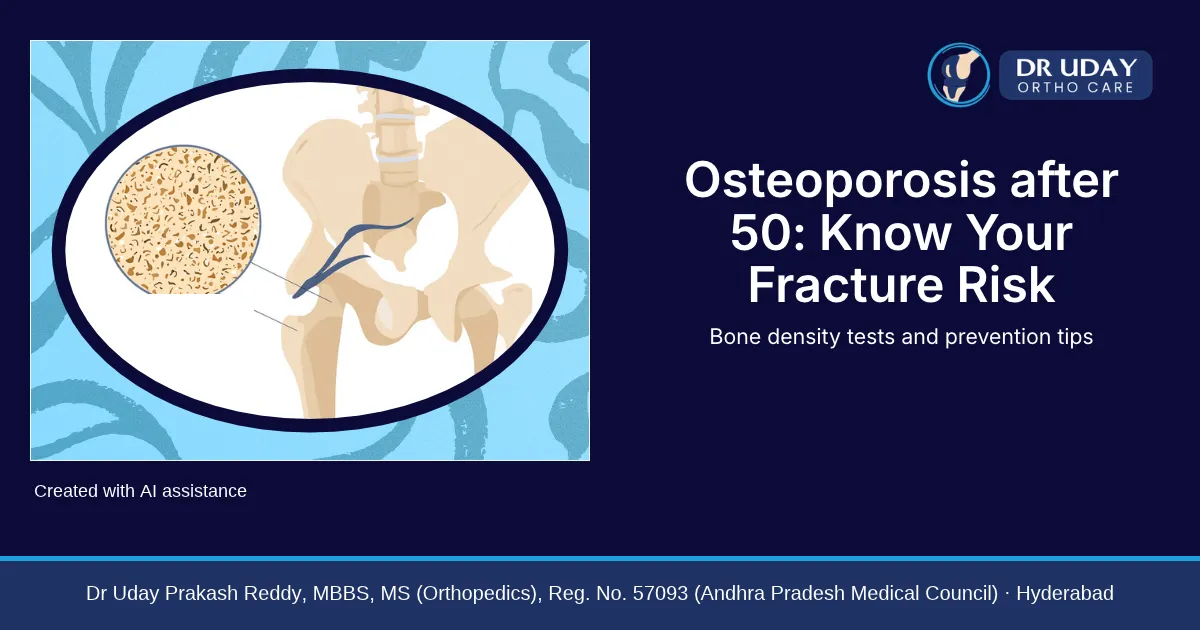
Osteoporosis makes bones lose strength until they can break after a minor fall, usually with no symptoms beforehand. After 50 a DEXA scan measures bone density and gives a T-score; -2.5 or lower means osteoporosis. Weight-bearing exercise, calcium and vitamin D, and a safer home all lower fracture risk.
Osteoporosis is a condition in which bones slowly lose strength until they can break after a minor fall. After 50, and especially after menopause, the risk rises. Most people feel nothing until a bone breaks. A bone density test (DEXA scan) shows where your bones stand. Simple daily habits, such as weight-bearing exercise, good nutrition and fall-proofing your home, can lower your risk.
Key points
- Osteoporosis usually causes no symptoms until a fracture, most often of the wrist, hip or spine.
- A DEXA scan measures bone density at the hip and spine and gives a T-score. A score of -2.5 or lower is in the osteoporosis range.
- Testing is commonly advised for women 65 and over, younger women past menopause with risk factors, and anyone over 50 who breaks a bone in a minor fall.
- Men get osteoporosis too, and they are tested less often.
- Weight-bearing and strength exercise, calcium and vitamin D, not smoking, less alcohol and a safer home all lower fracture risk.
What is osteoporosis, and why does it matter after 50?
Osteoporosis means bones have become thinner and more fragile than they should be. Bone is living tissue that is broken down and rebuilt all the time. As we age, bone is lost a little faster than it is rebuilt, and women lose bone quickly in the first few years after menopause. The result is not pain but fragility: a bone that breaks from a fall that once would have caused only a bruise.
The NHS describes it as a condition that develops slowly over years and is often found only when a fall causes a fracture. The breaks seen most often are the wrist, the hip and the small bones of the spine (vertebrae). A spinal fracture can happen without a fall, and over time it can lead to a stooped, bent-forward posture and loss of height.
The numbers are large. The International Osteoporosis Foundation estimates that after 50, about one in three women and one in five men will have a fragility fracture in their lifetime. In India, a large ICMR study found that bone density tends to be lower than in North American populations (Mithal et al., 2014). Low calcium intake, widespread vitamin D deficiency and early menopause add to the risk (Khadilkar & Mandlik, 2015).
From Dr Uday's practice: In my OPD, a common pattern is someone in their sixties who comes in with a wrist or hip fracture after a simple slip at home and has never had a bone density test. Often the fracture is the first time anyone has mentioned bone health to them.
Who is more likely to get osteoporosis?
Age and sex are the biggest factors: women past menopause and adults over 65 have the highest risk. Other factors include early menopause, a parent who broke a hip, low body weight, smoking, heavy drinking, long-term steroid tablets, and conditions such as rheumatoid arthritis or thyroid and gut problems that affect bone.
The NHS list of causes also includes:
- Menopause before 45, or removal of the ovaries
- Taking high-dose steroid tablets for more than three months
- Long-term use of some medicines that affect hormones or bone
- A low body mass index (BMI), or a past eating disorder
- Not exercising regularly
- Smoking and heavy drinking
The IOF adds two warning signs to watch for: a broken bone after 50 from a low-impact fall, and losing more than 4 cm of height.
What is a bone density test (DEXA scan)?
A DEXA (dual-energy X-ray absorptiometry) scan measures how dense your bones are, usually at the hip and lower spine. You lie still on a padded table while a scanner arm passes over you. It uses a very low dose of X-rays, needs no injection and usually takes 10 to 20 minutes.
What to expect:
- Wear clothes without metal zips, buttons or buckles, or change into a gown.
- Tell the staff if you might be pregnant, or if you recently had a scan with contrast dye.
- Lie on your back on the table. Your legs may rest on a cushioned block to flatten your lower back.
- Stay still while the arm passes over your hip and spine.
- The report goes to your doctor, who reads it together with your other risk factors.
What does my T-score mean?
The T-score compares your bone density with that of a healthy young adult. The further below zero it is, the thinner the bone. The World Health Organization groups the results into three bands, shown below. Your doctor reads the score together with your age and risk factors, not on its own.
| T-score | What it means |
|---|---|
| -1.0 and above | Normal bone density |
| Between -1.0 and -2.5 | Low bone mass (osteopenia) |
| -2.5 and below | Osteoporosis |
Based on the WHO classification, as summarised by the NHS.
Osteopenia is not a diagnosis of osteoporosis. It is a signal to pay attention. Many people with osteopenia never break a bone, especially if they keep active and look after the other risk factors.
Doctors often combine the scan with a fracture-risk tool such as FRAX. FRAX estimates your chance of a hip or other major fracture over the next ten years, and an India-specific version is available (CMC Vellore, J Family Med Prim Care 2019).
Who should get a bone density test, and when?
Guidelines differ slightly, but they agree on the main groups. Women 65 and over are usually advised to have a test. So are women under 65 who have passed menopause and have risk factors, and anyone over 50 who breaks a bone in a minor fall. Some groups also advise testing men from 70, or earlier with risk factors. In India, testing is often advised earlier.
The US Preventive Services Task Force (2025) recommends screening:
- All women aged 65 and over
- Postmenopausal women under 65 whose clinical risk assessment shows a higher fracture risk
For men, the USPSTF says there is not yet enough evidence for routine screening. Other bodies, such as the US Bone Health and Osteoporosis Foundation, do advise testing men aged 70 and over, and men aged 50 to 69 with risk factors.
How often the test is repeated depends on the first result and on any treatment, so your doctor decides this case by case.
Do men get osteoporosis?
Yes. Men lose bone more slowly than women, but age, smoking, heavy drinking, long-term steroid tablets and low testosterone all raise the risk. Men are tested less often, so it is frequently missed until a fracture. A man over 50 who breaks a bone in a minor fall should ask about his bone health.
How can you lower your fracture risk after 50?
Prevention works on two fronts: keeping bone as strong as possible, and making falls less likely. Most of it is daily habit rather than anything complicated.
1. Keep moving, with the right kind of exercise
The NHS recommends weight-bearing exercise, where your feet and legs carry your weight, such as brisk walking, dancing or tennis. It also recommends resistance exercise such as light weights or resistance bands. Swimming and cycling are good for the heart but are not weight-bearing. If you already have osteoporosis, check with your doctor or physiotherapist before starting something new.
2. Train your balance
Most hip fractures in older adults follow a fall. Reviews of trials in older adults show that balance and combined strength-and-balance programmes reduce falls and fall injuries (Frontiers in Public Health, 2023). Simple standing balance practice, yoga or tai chi under guidance can all help.
3. Eat for your bones
Include calcium-rich foods such as milk, curd, paneer, ragi, leafy greens and sesame. Vitamin D helps the body absorb calcium. Whether you need a supplement, and how much, is something to decide with your doctor. Please don't self-medicate.
4. Cut back on smoking and alcohol
Both are linked to faster bone loss. Stopping smoking at any age helps.
5. Make your home safer
- Keep floors free of loose rugs, wires and clutter.
- Use night lights between the bedroom and bathroom.
- Fit grab rails in the bathroom and use a non-slip mat.
- Wear well-fitting footwear with a good grip.
- Have your eyesight checked regularly, and ask your doctor whether any of your medicines cause dizziness.
What happens if I am diagnosed with osteoporosis?
A diagnosis does not mean a fracture is certain. Your doctor will look at your overall fracture risk and may check blood tests for causes such as low vitamin D or thyroid problems. Most care is non-surgical orthopaedic treatment: exercise, nutrition and fall prevention, with bone-strengthening medicines when they are needed.
If a fracture has already happened, the focus is on fracture care that helps it heal well, and then on preventing the next one. Getting back to safe movement with physiotherapy is part of that.
Sources
- NHS – Osteoporosis
- NHS – Osteoporosis prevention
- International Osteoporosis Foundation – World Osteoporosis Day
- International Osteoporosis Foundation – risk factors
- US Preventive Services Task Force – Osteoporosis screening (2025)
- Mithal A, et al. Asia-Pacific Regional Audit: osteoporosis in India. Indian J Endocrinol Metab, 2014
- Khadilkar AV, Mandlik RM. Osteoporosis in women: an Indian perspective. Int J Womens Health, 2015
- Fenton A. Commentary on the Indian Menopause Society guidelines. J Mid-life Health, 2020
- Utility of FRAX in primary care in India. J Family Med Prim Care, 2019
- Exercise interventions for fall prevention in older adults. Frontiers in Public Health, 2023
- IAEA – Radiation protection of patients during DXA
This article is for general awareness and does not replace a medical consultation. Consult a qualified doctor if you have symptoms or concerns about your bone health.
About the Author
Dr. Uday Prakash Reddy
Senior Consultant Orthopedic Surgeon at Continental Hospitals, Hyderabad, with over 24 years of experience in orthopedics, arthroscopy and joint replacement.